Friday, October 03, 2008
Friday, September 12, 2008
What kind of people would deny Muslim meatpackers food break at sunset in Ramadan?
DENVER (Reuters) - Meat processor JBS Swift & Co. has fired 130 Muslim workers after they refused to return to work in a dispute with the company over Ramadan fasting and meal breaks, company and union officials said on Thursday.
Manny Gonzales, spokesman for the United Food Workers Commercial Workers Local 7, said the employees were "unjustly terminated" from the meatpacker's plant in Greeley, Colorado, about 60 miles northeast of Denver.
"They (the workers) were not given adequate notice that they would be let go," Gonzales said. "We will file grievances for those who want their jobs back.
Swift, owned by Brazilian meat company JBS, the world's largest beef producer, had another dispute with Muslim workers last year at the company's Grand Island, Nebraska, plant. Several workers were fired after leaving their jobs to pray at sunset.
In announcing the firings, Swift spokeswoman Tamara Smid said the company adjusted its meal breaks to help workers concerned about observing the Islamic holy month of Ramadan. Those dismissed, she said, lost their jobs for violating a collective bargaining agreement, not because of their faith.
"JBS is grateful to employ a multicultural work force and works closely with all employees and their union representation to accommodate religious practices in a reasonable, safe and fair manner to all involved," she said.
The dispute began when 220 Muslim workers -- mostly immigrants of Somalia and other East African nations -- walked off the job this week after supervisors denied them a food break at sunset.
During Ramadan, devout Muslims fast from dawn to dusk.
The workers were suspended for an "unauthorized work stoppage" and were told to return to the job or be fired, Smid said.
Despite the failure of negotiations between management and the union to resolve the dispute, some of the employees returned to work, but the 130 who did not were terminated.
Many of the African immigrants were hired at the plant after a 2006 raid by U.S. immigration authorities resulted in the detention of 1,300 Swift workers in six states. Most of those workers were Hispanics whom the government said were in the United States illegally.
Labels: Muslims in the West, outrage, Ramadhan
Where do Muslims in Paris break their fasts?
PARIS (Reuters) - It's sunset in the French capital, and hundreds of hungry people are poised to begin their meals at the sounding of a Muslim call to prayer.
Elsewhere in the world, the call rings forth from the minarets of mosques, but inside a tent in a gritty part of north Paris, it comes from a tinny radio speaker.
For the holy month of Ramadan, a soup kitchen has opened outside Cite Edmond Michelet, a tough public housing project in Paris' notorious 19th arrondissement. On the menu is a traditional dinner, starting with yoghurt and dates.
"A lot of people can't make ends meet nowadays, but they'd never tell you," said Ali Hasni, 45, a volunteer for the non-profit group "Une Chorba Pour Tous" (Soup for Everyone).
France is home to Europe's largest Muslim minority and debate about the integration of these 5 million people into an avowedly secular society is a recurring theme in a political arena where only a handful of Muslims hold government posts.
The tower blocks surrounding the tent are a common sight in the French urban landscape.
Often run down, the forbidding high-rises are home to many Muslim immigrants who came here to work in the construction boom of the 1960s and 70s, as well as immigrants from other faiths.
Many tower blocks were on the frontline in 2005 when mainly immigrant youths rioted across France after two teenagers were accidentally electrocuted in a power sub-station after a run-in with police. Violence has flared sporadically in many such neighborhoods since then.
The 19th arrondissement tops Paris' violent crime statistics, and unemployment is rife. But the soup kitchen's organizers are unfazed by its reputation.
"We adapt to wherever the mayor lets us set up shop, tough neighborhood or not. But we'd really like a more permanent address since demand rises every year," said Farid Adjadj, a 34-year-old postal worker who's been a volunteer since 1994.
While fights between groups of Arab Muslims and young Orthodox Jews make the local papers in the 19th every few months, some residents say tensions are under control.
"This is one of the most populous parts of Paris, and we get along very well -- I just wish that were the same in the Middle East," said David Siksik, a Jewish volunteer.
BIG TOP
The tent, known as "the big top", stretches across several basketball courts. Most of those shuffling in are men on their own. Many speak in Arabic as they settle in at long tables set with plastic tableware.
The main dish is a spicy stew that is eaten -- in dozens of variations -- across North Africa, the Middle East, Southern Europe, Turkey and India. Here it's called "chorba" -- a French transliteration of the Arabic word for soup.
Une Chorba Pour Tous, which mostly targets poor Muslims, has been operating since 1992. Its 150,000 euro ($212,000) annual budget from private donations and public grants allows it to provide some 700 meals a day year-round.
But it is busiest at Ramadan when it serves an average of 2,000 meals per night. Charity is a religious duty in Islam.
"Charity is all the more important during Ramadan, and most of our volunteers are Muslim. But we don't exclude anyone who needs help or wants to help," said Fanny Ait-Kaci, 56, one of the group's founding members.
RICH COUNTRY
Food prices in France rose by 6.4 percent annually in July -- although overall consumer inflation eased 0.3 percent from the previous month -- and charities say many, especially the poorest, have been struggling to make ends meet.
Soup kitchen volunteers say most people who come to the tent are not homeless, but poor immigrant workers or solitary unemployed who, above all, miss living in a community.
"Many people come but wouldn't want their families to know they're here, especially since they might think they're living the high life in a rich country," Hasni said.
President Nicolas Sarkozy's government has angered many immigrant groups by cracking down on illegal immigration, but he has also championed labor reform as a way to fight poverty.
Unemployment has fallen almost a full point since he took office last year, but has since leveled off at 7.6 percent.
France does not keep official statistics on religion or ethnic background, so it's hard to see who is most affected by joblessness.
In the meantime, the soup tent fills.
"I live in a hotel and can't cook, so I came here -- if it weren't for this association I wouldn't be able to break the fast properly," said Karim, 32, an unemployed waiter who declined to give his last name.
"There's no real Ramadan spirit in my neighborhood in (more upscale) western Paris, but here, there's all we need," said Salima Hajjaj, a hairdresser who had come with her unemployed husband and three children.
Labels: Muslims around the world, Muslims in the West, Ramadhan
Tuesday, April 08, 2008
What do 1.3 billion Muslims think?
The jury's still out on that one.
Labels: Muslims around the world, Muslims in the news, Muslims in the West, what do Muslims think?
Tuesday, March 25, 2008
Are you on The List?
Makes for a slightly spooky, very sad read.
You get in line where it says “US citizens” and await your turn to have your passport stamped by the Customs agent. As you come up to his cubicle you are relieved to see that the smiles really are there. The agent greets you with a “Welcome home!” as he takes your passport. As he scans it, he asks you the typical questions: “Where were you? How long did you stay? What was the purpose of your visit?” The problem is that all of a sudden the smile disappears and they don’t really seem to be paying attention to your rambling on about the crazy drivers in Rome. They seem taken aback by some ominous message which appears to have come up on their computer. The poor agent in fact looks very distraught at whatever it is he sees. He reads it again to be sure. Then he tells you in a very serious voice, the smile long having faded, that you need to step to the wall or to the side and wait for another “agent”.
“Is there a problem?” you ask in a concerned voice. “No, just a random check,” comes the traditional reply. You are then led to a room by a not-so-smiley “agent” who clearly appears to have no interest in small talk. About all he does is reiterate the “random check” line you were given before. He leads you over to the luggage claim area and stands back while you reclaim all the luggage they will soon pore over with a fine tooth comb. After a tense 15 minutes awaiting your bags, you are then led to a room off to the side – in some cases behind an ominous one-way mirror – where you discover several other Muslims who have also been selected for this “random” humiliation and degradation. Concerned eyes of other passengers you accompanied on the plane follow you all the way until you are behind the one-way mirror.
You are gruffly told to take a seat by your latest handler for what looks like a long wait. As you scan the room, you are saddened by the terrified looks of hijabis in their 50s and 60s who look like they could be your mother. What could they have possibly done to be treated like this? For that matter, what could any of us have done? The “war on terror” takes more collateral damage it appears.
After a wait of anywhere from 30 minutes to over an hour, the “agent” who brought you here asks you to come over to a steel table where they proceed to take every item out of your bags to do a thorough search. Any paper with any addresses, phone numbers, names or other information of a personal nature is taken for photocopying. God forbid you should have anything in Arabic other than a Qur’an because that too will need to be taken for photocopying and can increase your detention and interrogation time to hours. While they scour through your personal belongings, they do their version of “casual” interrogation. Every question is usually asked twice during the questioning to ensure that you aren’t lying or making anything up. They at last come to the contents of your pockets. Be ready to surrender your driver’s license and credit cards for “photocopying” as well. Don’t worry though – it’s all just “random”.
After that ordeal, which seems very adept at making most everyone who goes through it feel like a criminal even if they never even had a parking ticket, you are commanded to once again sit among the other randomly selected (read Muslim) passengers. It is not uncommon to have another agent come and request your connecting flight information, “because it looks like we will need to book you on a later flight”. You may be emboldened by this point, if not before, to ask why this keeps happening to you if you are a frequent international traveler, but you will only get the same “it’s random” response. You will not be offered any information to help make any sense out of this whole experience, nor a method for resolving whatever seems to be the issue.
Once everything seems to have cleared to CBP’s satisfaction, you are then “free to go.” Sorry if there are no more connecting flights and you have to spend the night in whatever city you are, or if your family is worried sick because you are several hours late because you can’t use your phone until after you pass the screening area. In fact, you should be grateful for this new addition to national security.
Those of you who have never experienced this may wonder if there is a wee bit of exaggeration in this article, but unfortunately the above-mentioned phrases are based on personal experiences of several Muslims in the past six months. This article is designed to make those of you not on the infamous “terror watch list” or “no-fly list” aware of what does happen to the rest of us and to help guide those who are wrongly on this list to a pathway to legally get off and feel human again."
Labels: Muslim baiting/bashing, Muslims in the West, outrage
Friday, February 08, 2008
How Muslim Pomaks in Bulgaria kept their wedding traditions alive
"Maybe we are at the end of the world. Or people in Ribnovo are very religious and proud of their traditions."
Bulgaria is the only European Union nation where Muslims' share is as high as 12 percent. The communist regime, which did not tolerate any religious rituals, tried to forcibly integrate Muslims into Bulgaria's largely Christian Orthodox population, pressing them to abandon wearing their traditional outfits and adopt Slavonic names.
People in Ribnovo identify themselves more by their religion, as Muslims, than by their ethnicity or nationality, and the wedding ceremony is an expression of their piety. The village has 10 clerics and two mosques for 3,500 inhabitants.
Labels: Muslim practices, Muslims around the world, Muslims in the West
Thursday, January 17, 2008
How prejudiced can people get?

from: Yahoo News
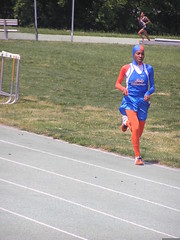
Juashaunna Kelly, a senior at the District of Columbia's Theodore Roosevelt High School, has the fastest mile and 2-mile times of any girl runner in the city this winter. She was disqualified from Saturday's Montgomery Invitational indoor track and field meet.
The outfit allows her to compete while adhering to her Muslim faith, which forbids displaying any skin other than her face and hands.
"It's not special," Kelly said. "It doesn't make me perform better."
But meet director Tom Rogers said Kelly's uniform violated rules of the National Federation of State High School Associations, which sanctioned the event. Uniforms are required to be "a single-solid color and unadorned, except for a single school name or insignia no more than 2 1/4 inches," he said.
Rogers said that he knew Kelly was wearing the uniform for religious reasons and that he offered her several options to conform to the rules while still respecting her faith, including placing a plain T-shirt over her unitard and then wearing her team uniform over it.
Kelly's mother, Sarah, and Roosevelt Coach Tony Bowden disputed that account. They said officials made several demands of her daughter before Rogers made his decision.
"First, they said she had to take her hood off," Sarah Kelly said. "Then, they said she can't have anything with logos displayed. Then, they said she had to turn it inside out. When I told them that there weren't any logos on it, they said she had to put a plain white T-shirt on over it."
Juashaunna Kelly has worn the same uniform for three years without any problems, including at last year's Montgomery Invitational. Rogers said officials must have missed the uniform last year.
"It wasn't a problem last year, and it's a problem this year? Make me understand why," Bowden said.
Kelly, whose 1,600-meter time of 5 minutes 17.49 seconds and 3,200-meter time of 12:00.81 are the fastest of any D.C. girl, was hoping to run fast enough at the Montgomery Invitational to qualify for the New Balance Collegiate Invitational in New York on Feb. 8-9.
Bowden said the team has no other meets scheduled that would allow her to qualify for the event, which attracts dozens of college recruiters.
Labels: do Muslims and modernity mix?, Muslim youth, Muslims in the news, Muslims in the West, outrage
Thursday, December 13, 2007
A Muslim guy saving a Jewish man from a hate crime: that's a miracle?
NEW YORK, Dec. 12 (UPI) --
A Jewish man who allegedly was the victim of a hate crime in New York last week was saved from serious injury by a Muslim bystander, a report said.
The New York Post reported Wednesday that while Walter Adler was being attacked by several assailants on board a Q train, Bangladesh native Hassan Askari entered the fray and held off the attackers until police could board the train.
"A random Muslim guy jumped in and helped a Jewish guy on Hanukkah -- that's a miracle," Adler said of his rescuer during last Friday's attack.
Adler told police that a group of passengers allegedly attacked and insulted him and his friends after they responded to a Christmas greeting by wishing them a happy Hanukkah.
After police arrived, 10 people were arrested and six were charged with assault.
The Daily News said the individuals also face hate crime charges for their alleged actions, accusations at least one of the suspects has strongly opposed.
Labels: good news, Muslims around the world, Muslims in the news, Muslims in the West
Wednesday, October 31, 2007
What's the Muslim position on Halloween?
Historically, Halloween precedes the Christian feast of Hallowmas, All Hallows, or All Saints' Day. The observances connected with Halloween originated among the ancient Druids, who believed that on that evening, Saman, the lord of the dead, called forth hosts of evil spirits. The Druids customarily lit great fires on Halloween, apparently for the purpose of warding off all these spirits. Among the ancient Celts, Halloween was the last evening of the year and was regarded as a propitious time for examining the portents of the future. The Celts also believed that the spirits of the dead revisited their earthly homes on that evening. After the Romans conquered Britain, they added to Halloween, features of the Roman harvest festival held on November 1 in honor of Pomona, goddess of the fruits of trees.
The Celtic tradition of lighting fires on Halloween survived until modern times in Scotland and Wales, and the concept of ghosts and witches is still common to all Halloween observances. Traces of the Roman harvest festival survive in the custom, prevalent in both the United States and in Great Britain, of playing games involving fruit, such as ducking for apples in a tub of water. Of similar origin is the use of hollowed-out pumpkins carved to resemble grotesque faces and lit by candles placed inside.
Many will see this stance as "fanatic," but I take exception to that accusation. I will not parade the streets trying to prevent trick-or-treaters, Muslim or otherwise, from getting their candy. I will not put a sign on my door saying, "No candy here--Halloween is a pagan holiday and you will all burn in hell." My family and I simply will not participate in Halloween festivities."
Labels: integration issues, Muslim practices, Muslims around the world, Muslims in the West, what do Muslims think?
Saturday, July 14, 2007
Why don't Muslims shake hands with the opposite gender?
An opinion piece in a prominent Australian newspaper (incidentally by a Muslim) analyses the propensity of an increasing number of Muslims to refuse/shy away from shaking hands with the opposite gender...
Recently I have been caught out several times on this issue in public. On each occasion I was left feeling awkward, if not a little embarrassed. By the time I had figured out that the man did not shake hands, it was too late: my hand was left hanging in the wind.
It was hard not to take this personally, even though for Muslims who take this position it is nothing personal at all. They simply do not want to shake hands because they believe it is against their religion. To avoid seeming disrespectful, these men will often touch their heart as a sign of goodwill."
Labels: do Muslims and modernity mix?, integration issues, Muslims around the world, Muslims in the West, Muslims on Muslims
Are Doritos and Cheetos halaal or haraam?
Labels: fyi, Muslims in the West, what do Muslims think?
Monday, May 28, 2007
What does the Pew Report have to say about Muslim Americans?
May 22, 2007
Download the complete report here
The first-ever, nationwide, random sample survey of Muslim Americans finds them to be largely assimilated, happy with their lives, and moderate with respect to many of the issues that have divided Muslims and Westerners around the world.
Key findings include:
A large majority of Muslim Americans believe that hard work pays off in this society. Fully 71% agree that most people who want to get ahead in the United States can make it if they are willing to work hard.
The survey shows that although many Muslims are relative newcomers to the U.S., they are highly assimilated into American society. On balance, they believe that Muslims coming to the U.S. should try and adopt American customs, rather than trying to remain distinct from the larger society. And by nearly two-to-one (63%-32%) Muslim Americans do not see a conflict between being a devout Muslim and living in a modern society.
Labels: integration issues, Muslims in the West, what do Muslims think?
Wednesday, May 16, 2007
Who's the Muslim woman who has ''thrown Denmark in turmoil''?
The 25-year-old social worker, student and town councillor describes herself as a feminist, a democrat, and a socialist. She has gay friends, opposes the death penalty, supports abortion rights, and could not care less what goes on in other people's bedrooms. In short, a tolerant Scandinavian and European.
Labels: integration issues, Muslims in the news, Muslims in the West
Tuesday, April 17, 2007
Guess who've been called "model citizens" in Britain in the latest Gallup poll?
The Times
More than half identify very strongly with Britain, and about four in every five believe that it is important for integration to master the English language, get a better education and find a job.
The findings, to be revealed tomorrow, are the result of an independent survey of Muslim attitudes by the Gallup Organisation, and point to a much more hopeful outlook for integration than recent reports of extremism, alienation and a ghetto mentality have suggested.
The poll also finds that almost nine out of ten Muslims in London believe attacks that target civilians are unjustified and morally wrong — only 4 per cent fewer than the view of nonMuslims. Some 81 per cent also condemn violence even if used in a noble cause — a figure that is 9 per cent higher than the general public’s view.
But Muslims are overwhelmingly more likely to identify very or extremely strongly with their religion than nonMuslims — 69 per cent compared with 30 per cent.
Only 13 per cent of Muslims say it is necessary to remove the face veil (niqab ) for integration in British society, compared with 55 per cent of nonMuslims who see this as essential. Even fewer, 6 per cent, believe it necessary to remove the headscarf (hijab) compared with 21 per cent of nonMuslims who do think so.
The findings are part of a global survey of Muslim attitudes carried out by Gallup, which conducted face-to-face interviews with individuals aged 15 or older in 40 Muslim countries. As part of this survey, Gallup looked last year at how integrated Muslims were in three European countries — Britain, France and Germany — and how much they identified with their nations, their faith and their ethnicity.
Gallup found that there were still striking differences between London’s Muslims and nonMuslims on moral issues. Only about 10 per cent believed that sex outside marriage was acceptable, compared with more than 80 per cent of the general public. Even fewer — less than 5 per cent — found homosexual acts acceptable, compared with 65 per cent generally. Slightly more Muslims than nonMuslims accepted “honour killing” and crimes of passion, but the numbers in each case were tiny, at about 2 per cent. Abortion was acceptable to more than three times as many nonMuslims as Muslims, and there were similar big discrepancies on suicide and viewing pornography. Only on the death penalty were the figures fairly close, with about 36 per cent approval by Muslims and 43 per cent by nonMuslims.
The Gallup poll echoed similar polls which have shown that British foreign policy plays a large role in Muslim attitudes.
The poll is financed by the Gallup Organisation, and so claims that it has no partisan interest in any of the findings. It will be welcome news to many British Muslims, who complain that they are misrepresented as insular, extremist, mistrustful of the police and unwilling to integrate into British society.
Labels: integration issues, Muslims in the West, what do Muslims think?
Sunday, April 01, 2007
Is Canada's Passenger Protect Program nothing less than a “No-Fly” List?
And now we have another list to worry about.
Labels: Muslims in the West
Does good news about Muslims often get buried under a barrage of bad news?
Airport commissioners have expressed concern about cabbies refusing to pick up fares because of Islamic prohibitions against carrying alcohol. They also worry that Islamic rules about dogs might prompt drivers to decline rides when 300 visitors with guide dogs attend the American Council of the Blind convention in Minneapolis this summer.
Abdinoor Ahmed Dolal, a Muslim cab driver from Kenya, was stunned by the commissioners' concerns. The Qur'an places high value on assisting the disabled, he said. So Dolal says Muslim cabbies have offered to give blind conventioneers free rides to Minneapolis, forgoing the $30 fares as a sign of good will.
"The issues we have are so simple and have nothing to do with extremism or fanaticism," Dolal said. "We are Muslims and we are Minnesotans and if we sit down and listen to each other, we can work things out."
Labels: good news, integration issues, Muslims in the West